

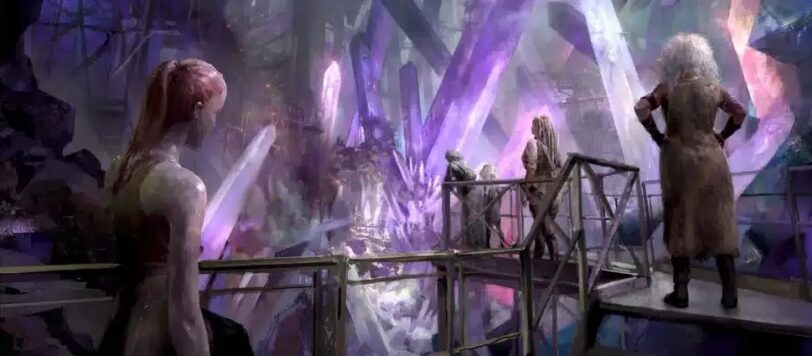
*Sci-fi Astronomy, edited by Camilla Pianta*
The Fifth Season, a world between science fiction and planetary geology 🏞️
What if tectonic processes were a fundamental ingredient of worldbuilding?
COUNTDOWN TO APRIL 2026, THE CENTENARY OF SCIENCE FICTION: -6
 Clicca qui per la versione italiana di questo articolo
“Here is a land.
It is ordinary, as lands go. Mountains and plateaus and canyons and river deltas, the usual. Ordinary, except for its size and its dynamism. It moves a lot, this land. Like an old man lying restlessly abed it heaves and sighs, puckers and farts, yawns and swallows. Naturally this land’s people have named it the Stillness. It is a land of quiet and bitter irony.
The Stillness has had other names. It was once several other lands. It’s one vast, unbroken continent at present, but at some point in the future it will be more than one again.
Very soon now, actually.”
N. K. Jemisin is the pen name under which the American writer Nora Keita Jemisin signs her works. Between 2016 and 2018 she rightfully entered the pantheon of speculative fiction thanks to winning no fewer than three consecutive Hugo Awards, one for each novel of the trilogy known as The Broken Earth, which began with The Fifth Season and continued with The Obelisk Gate and The Stone Sky. Never before had the genre’s top honour for Best Novel been awarded three times in a row to the same author — let alone for works from one and the same trilogy. This achievement is truly historic, since Jemisin was also the first African American author ever to win a Hugo Award for a novel.
The narrative of The Fifth Season unfolds on a world shaped by a lone supercontinent, the Stillness, echoing Earth’s Pangaea some 250 million years in the past. Battered by violent earthquakes and devastating volcanic eruptions, the Stillness is periodically — every few centuries — plunged into what is called the Fifth Season, a catastrophic climatic and environmental upheaval. Be it volcanic ash veiling the sunlight, toxic algae spreading through the waters, or tectonic faults tearing the continent apart — compounded by the pollution of a mining industry intent on turning disaster into profit — the people of the planet share one unshakable truth: sooner or later, the Fifth Season will arrive. In consequence, their culture and social organisation revolve around the necessity of readiness for that critical moment. From a young age, each individual is given a specific role that ensures the survival of the community, such as obtaining food or protecting supplies, and those who resist these strict obligations are cast out and left to face their fate alone.
Yet there are certain individuals, the orogenes, who possess the mysterious ability to influence geological phenomena: feared and despised for being different, some are imprisoned and forced to use their powers to serve the wealthy and those in power. In the words of the essayist and science fiction author Annalee Newitz (The New York Times, 2016), this scenario “should feel familiar to anyone living on Earth who follows current events, woven as they are from mounting environmental threats and the oppression of minorities.”
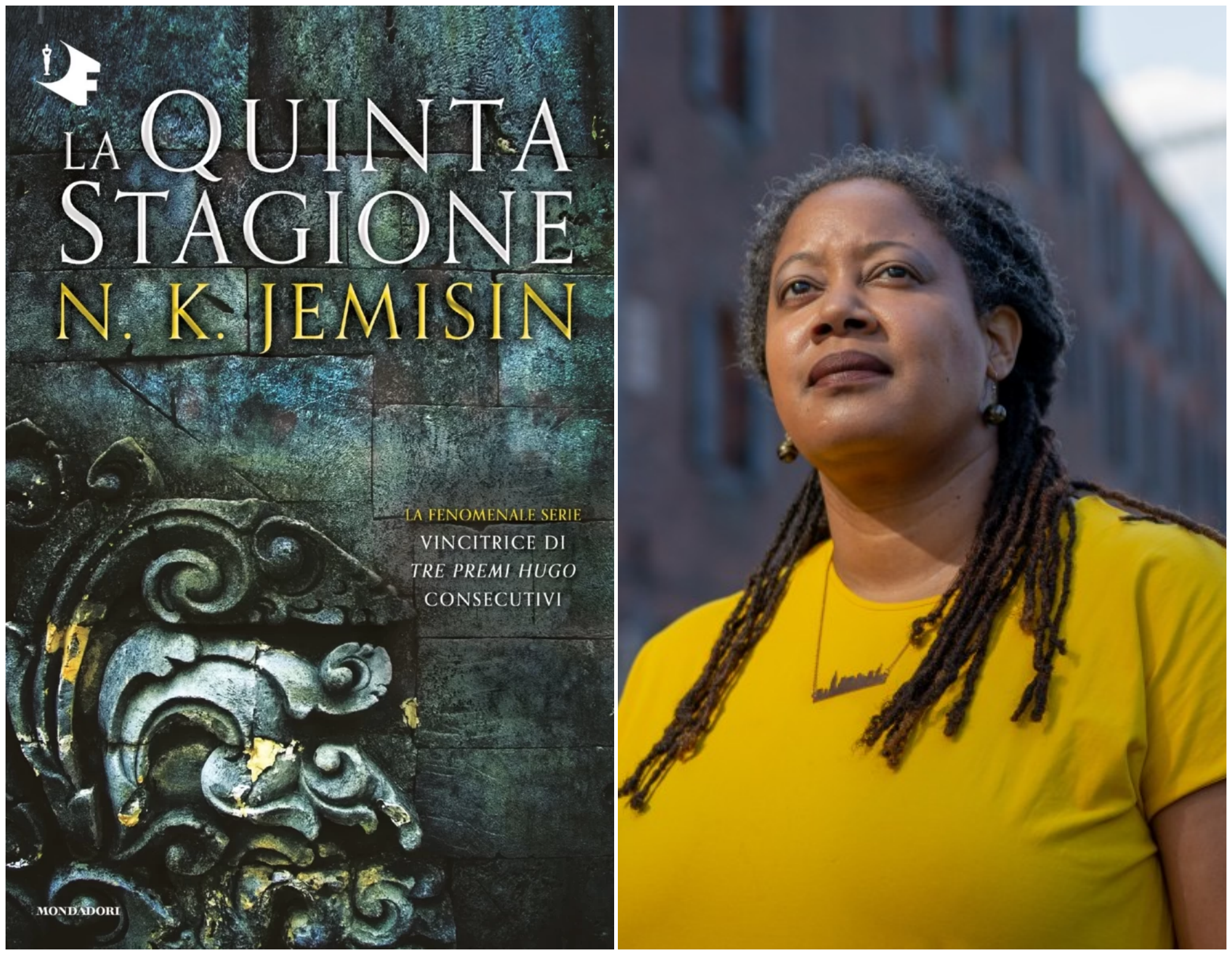
Newitz also emphasises how The Fifth Season sheds a light on scientific disciplines often marginalised in speculative literature — like geophysics and planetology —, presenting them as central elements that drive the story forward. It is impossible to separate the events and the characters’ personalities from the environment that surrounds them and has moulded their psyche. Similarly, understanding the properties and behaviours of celestial bodies in the Solar System — whether rocky planets, icy moons of giant planets, asteroids, or comets — requires deciphering the physicochemical processes occurring both within them and on their surfaces.
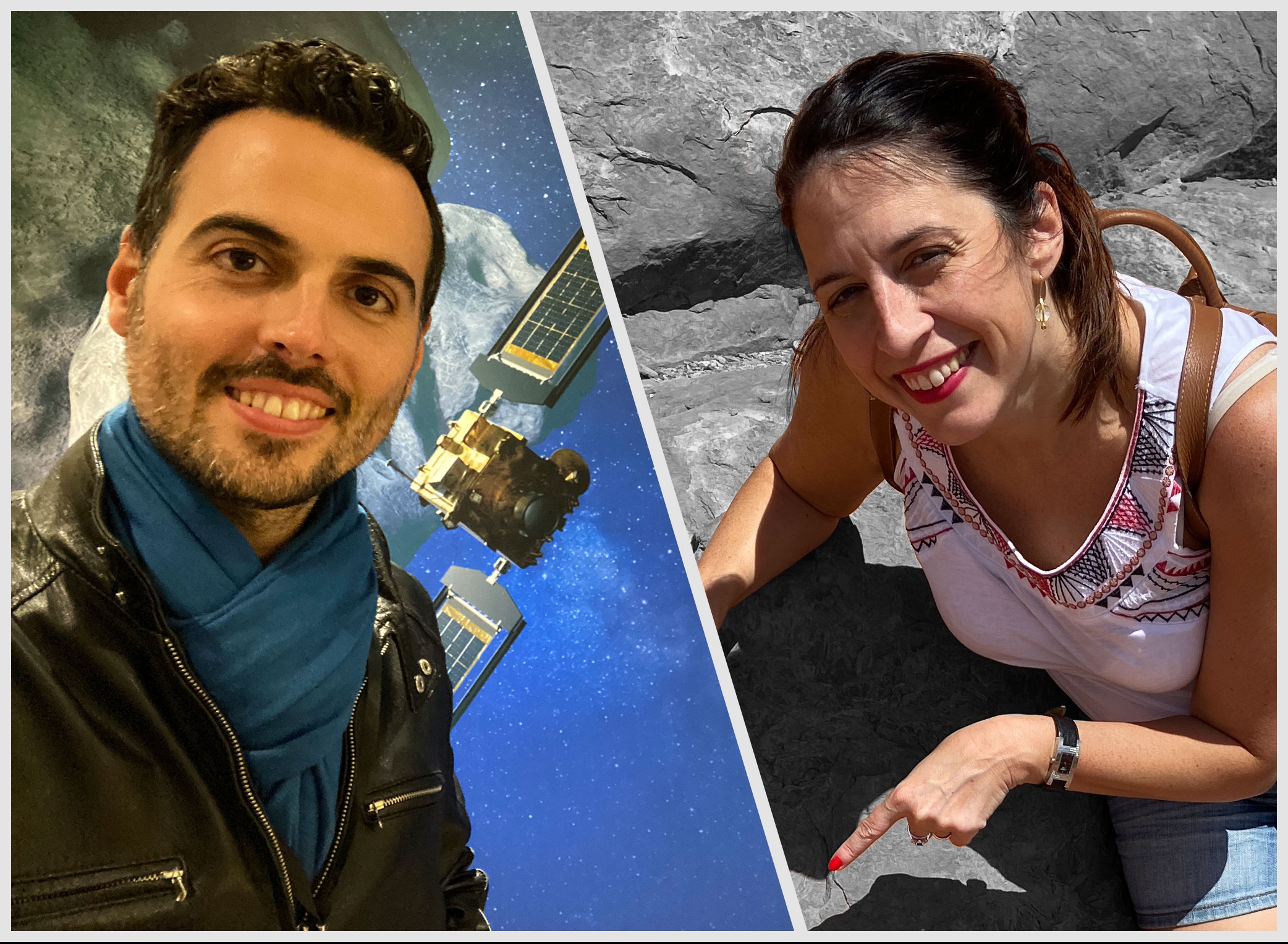
This is exactly the realm of planetologists Alice Lucchetti and Maurizio Pajola, prominent experts in planetary geology. Both trained in Astronomy in Padua and now researchers at INAF (the Italian National Institute for Astrophysics) in the same city, Lucchetti and Pajola offer two complementary and highly detailed perspectives on the planets and minor bodies of the Solar System.
During her doctoral studies in space science and technology, Lucchetti concentrated on characterising Jupiter’s icy moons, particularly Callisto, Europa, and Ganymede. She also contributed to the European Space Agency’s Rosetta mission, examining images captured by both the orbiter and the Philae lander of comet 67P/Churyumov–Gerasimenko. Currently, she is engaged in ESA missions such as JUICE (JUpiter ICy moons Explorer), DART (Double Asteroid Redirection Test), LICIACube (Light Italian Cubesat for Imaging of Asteroids), and HERA (named after the Greek goddess Hera), where she analyses data collected by cameras and spectrometers. On the other hand, Pajola, holding a PhD in astronautics and satellite science, centres his research primarily on Mars, with special attention to its geomorphology and the identification of landing sites for space missions, while also exploring the distribution of boulders on comets like 67P and 103P/Hartley 2, and determining the composition of asteroids.
“Planetary surface studies,” Lucchetti explains, “rely on the collection of multifilter images and spectrometric data. This integrated method broadens the observational range from visible to infrared wavelengths, enabling the investigation of both geomorphological and compositional features.” Images serve as an essential diagnostic tool for detecting fractures, landslides, impact craters, volcanic formations, and deposits of ice or dust. By inspecting the same regions through images taken at different times, researchers can track surface changes and gain valuable insights into ongoing geological processes.
For instance, crater counting is the chief method used to estimate a surface’s relative age: crusts that are heavily cratered, like Callisto’s, indicate prolonged exposure to impacts and are thus considered older, whereas surfaces with fewer craters, such as Europa’s, are regarded as geologically younger because they have undergone post-impact resurfacing. Furthermore, on icy satellites, crater shapes — whether bowl-shaped, with peak rings, or with domes or central peaks — are connected to the stratigraphy beneath the surface; notably, icy or porous layers just below the crust may be produced by diapiric or cryovolcanic activity, which push liquid and icy material up from the interior. Instead, fractures — whether tensional, like those on Ganymede, or compressive, as on Mercury — record the deformational history of the body in question, so that the predominance of one type over the other helps reconstruct past tectonic movements. Finally, landslides not only testify to surface instability under the influence of external forces, but also provide clues about internal composition: those that travel farther from their detachment point may be propelled by volatile materials underground.
“Among the icy satellites,” Lucchetti continues, “the most emblematic case is undoubtedly Enceladus, one of Saturn’s moons. Observations by the Cassini probe have shown a surface covered by a thick ice shell that thins toward the south pole, where four main fractures — the tiger stripes (named after the markings on the coat of the great Asian feline) — episodically emit jets of water vapour, dust, and ice particles. These plumes, similar to terrestrial geysers, arise from the internal pressures of a subsurface salty ocean, which is heated and kept liquid by Saturn’s tidal forces. Conversely, the north pole appears much more static, marked by craters but lacking fractures.”
“The Martian environment, too,” adds Pajola, “is extremely dynamic. Its hydrological history reveals that during the Noachian era — the oldest period, dating back roughly four billion years — the planet maintained an active water cycle, with rivers, lakes, and possible ocean basins. The deltaic mouths and branching river networks still discernible today are evidence of runoff processes, that is, the surface movement of liquid water, triggered by the erosion of the mountains from which the channels originated. The gradual vanishing of water led to genuine cataclysms, such as the sudden release of large volumes of water from buried reservoirs or trapped ice, and the formation of enormous outflow channels — drainage channels whose northward course was steered by the crustal dichotomy between Mars’s elevated southern hemisphere and its lower northern one.”
The subsequent loss of the planet’s magnetic field left Mars more vulnerable to bombardment by charged particles from the solar wind: the more volatile hydrogen was rapidly lost to space, while oxygen combined with rocks, enriching them in iron oxides and conferring the planet its distinctive red hue. The residual Martian atmosphere, composed of about 95% carbon dioxide and far less dense than Earth’s, imposes critical aerodynamic conditions for landing systems, leading to significant operational difficulties in exploration. Additionally, winds and periodic global storms can shroud the entire planet for weeks or even months, lifting enormous quantities of dust. By contrast, dust devils — local vortices of dust — represent an ambivalent phenomenon: while generally dangerous to rovers, they have at times swept their solar panels clean, thereby increasing their energy efficiency. “For all these reasons,” Pajola concludes, “landing sites are selected with great caution, avoiding both transition zones between highlands and lowland basins and regions prone to landslides or strong winds”.
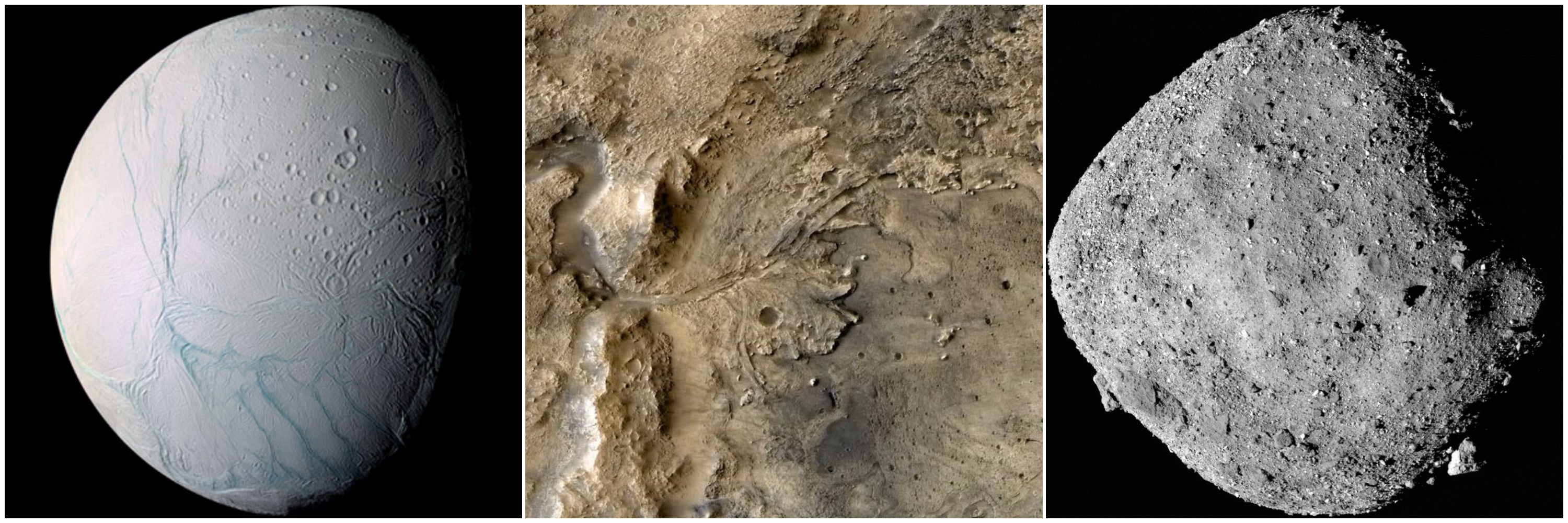
The study of asteroids completes the picture. “The main belt between Mars and Jupiter,” Pajola points out, “hosts bodies that can be perturbed by gravitational resonances — especially with Jupiter — and by interactions with other planets, which can move them onto NEO (Near-Earth Object) trajectories. Some of these asteroids, classified as PHAs (Potentially Hazardous Asteroids), intersect Earth’s orbit at distances close enough to entail a serious threat in the event of an impact; therefore, alongside constant monitoring from Earth, space missions such as DART and HERA implement strategies to alter their trajectories and reinforce planetary defence. But asteroids are more than just that: in fact, they contain complex organic molecules, including nitrogenous bases and amino acid precursors, the fundamental building blocks of terrestrial life. It is hence likely that asteroids helped transport some of this organic material to primordial Earth.”
The research conducted by Alice Lucchetti and Maurizio Pajola demonstrates the vital importance of comparative planetology. Only by examining fractures, craters, cryogenic deposits, erosion processes, and mass movements across multiple bodies can the physical and chemical mechanisms underlying geological phenomena, also observed on Earth, be isolated and understood. Moreover, this approach invites reflection on the origin of life and on the capacity of societies — whether real or imagined — to adapt to unstable worlds, poised between catastrophe and possibility, like the one depicted in The Fifth Season
Acknowledgment is also due to Costanza Rossi, Matteo Massironi, Filippo Tusberti, Joel Beccarelli, Pietro Fraccaroli, Giovanni Munaretto, colleagues of Alice Lucchetti and Maurizio Pajola.

In these final lines, we wish to pay tribute to Riccardo Pozzobon, a valued friend and colleague of Alice Lucchetti and Maurizio Pajola, who recently passed away. Through his passion and expertise, Riccardo illuminated the path to knowledge of planetary geology, etching an indelible mark on the scientific work of his research group. Beyond his academic dedication, we remember his humanity and devotion to his family. We thus extend our deepest sympathy to his partner and son, who will forever carry forward his intellectual legacy and influence in their lives. To support them during this remarkably difficult moment, an online fundraising campaign has been established with the assistance of the La Venta Association. The funds raised go directly to the family, without intermediaries:
👉 https://buonacausa.org/cause/riccardopozzobon, in Italian
Nus, 3 ottobre 2025 – English version published on 23 May 2026
Astroglossary
resurfacing: in planetary geology, it indicates the process by which the surface of a planetary body is modified such that older features are erased or buried by new material, resulting in a younger-looking surface. This reshaping can occur through various mechanisms, either endogenous—such as tectonic activity and volcanism—or exogenous, such as impacts.
run-off: the movement of liquid water or other surface fluids flowing across the surface of a planetary body, such as a planet or a moon, without infiltrating into the subsurface, and contributing, for example, to sediment transport and landscape erosion.
outflow channels: geological structures visible on the surfaces of planetary bodies that are believed to have been carved by the rapid and massive outflow of large volumes of liquid water, such as catastrophic floods.
References
Internet Speculative Fiction Database: N. K. Jemisin, The Fifth Season, every edition
“‘The Fifth Season’ by N.K. Jemisin”, Annalee Newitz reviews the novel on The New York Times
Google Scholar: scientific papers by Alice Lucchetti
Google Scholar: scientific papers by Maurizio Pajola
Media INAF: Informing articles on Alice Lucchetti’s research, in Italian
Media INAF: Informing articles on Maurizio Pajola‘s research, in Italian
Il Bo Live: “Una vita per la ricerca”, articolo in ricordo di Riccardo Pozzobon, in Italian
ESA Caves & Pangaea Blog: “A tribute to Dr Riccardo Pozzobon”
👉 Click here for other articles of the series Sci-fi Astronomy, edited by Camilla Pianta
