

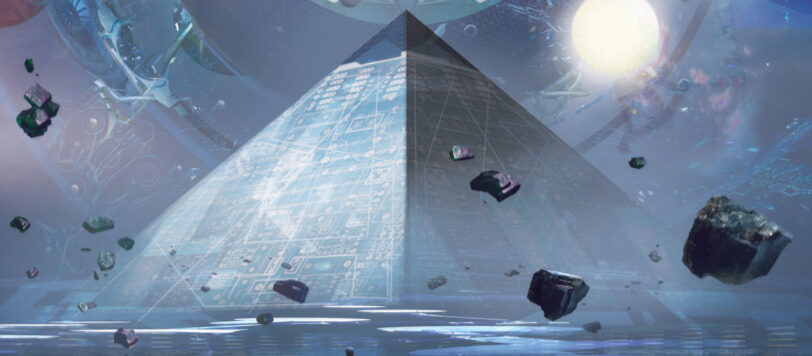
*Sci-fi Astronomy, edited by Camilla Pianta*
The Three-Body Problem, a question of deterministic chaos ✨
What if physics had never existed and the universe were uncontrollable?
COUNTDOWN TO APRIL 2026, THE CENTENARY OF SCIENCE FICTION: -2
 Clicca qui per la versione italiana di questo articolo
“After calming himself and walking to the other end of the long table, Wang said, «It’s actually pretty simple. The reason why the sun’s motion seems patternless is because our world has three suns. Under the influence of their mutually perturbing gravitational attraction, their movements are unpredictable—the three-body problem. When our planet revolves around one of the suns in a stable orbit, that’s a Stable Era. When one or more of the other suns move within a certain distance, their gravitational pull will snatch the planet away from the sun it’s orbiting, causing it to wander unstably through the gravitational fields of the three suns. That’s a Chaotic Era. After an uncertain amount of time, our planet is once again pulled into a temporary orbit and another Stable Era begins. This is a football game at the scale of the universe. The players are the three suns, and our planet is the football.»”
Thus Wang Miao, a physicist specialised in nanomaterials and protagonist of novel The Three-Body Problem by the Chinese writer Liu Cixin (1963), finds himself drawn into a series of mysterious suicides that upset the Chinese scientific community: numerous leading researchers take their own lives in suspicious circumstances, apparently connected to the psychological pressure caused by a deeply unsettling discovery. Trying to understand what is happening, Wang is introduced to a video game called Three Body, set on Trisolaris, a planet subjected — much like a ball continuously kicked around in a cosmic football match — to the joint influence of three suns. Its inhabitants are the Trisolarans, a technologically advanced alien civilisation that uses the game to recreate, with extraordinary realism, the hardships of their world. By transmitting signals that interfere with laboratory equipment and the human brain, the Trisolarans establish a direct communication line with scientists, sabotaging particle accelerator experiments and generating highly destabilising mental illusions. Among these are menacing and disturbing visions projected into the field of view, such as a clock marking an inexorable countdown. So concrete is the experience that it cannot be dismissed or explained by any known physical laws: if the universe itself seems uncontrollable, what sense can be made of scientific research? It is this very loss of existential meaning that drives scientists — consumed by a pervasive feeling of instability, mirroring the absolute precariousness of the Trisolaran system — to commit suicide.
Liu Cixin (where the surname precedes the given name according to Chinese convention), is widely recognised as one of the foremost contemporary science fiction authors. The novel The Three-Body Problem, first serialized in the Chinese science fiction magazine Science Fiction World (科幻世界, kēhuàn shìjiè) and later published as a single volume in the People’s Republic of China in 2008 under the original title 三体 (Sān tǐ, literally ‘Three Bodies’), opens the Remembrance of Earth’s Past trilogy. However, international success would only arrive in 2014, following the English translation by Ken Liu (1976), an American science fiction author of Chinese origin, which established the plot of The Three-Body Problem among the most compelling stories in hard science fiction. The Italian translation, completed by Benedetta Tavani based on Ken Liu’s version, finally appeared in 2017. In the meantime, the work, which had already received the highest accolades for science fiction literature in its home country, won the Hugo Award for Best Novel in 2015—marking the first time ever that an Asian author had claimed the most prestigious prize in world science fiction.
Ranging effortlessly from the Chinese cultural revolution to stellar and planetary astrophysics, the novel has in recent years regained popularity following its television adaptation into the Netflix series of the same name, developed by David Benioff (1970) and D.B. Weiss (1971), already renowned for their work on Game of Thrones, in collaboration with Alexander Woo.

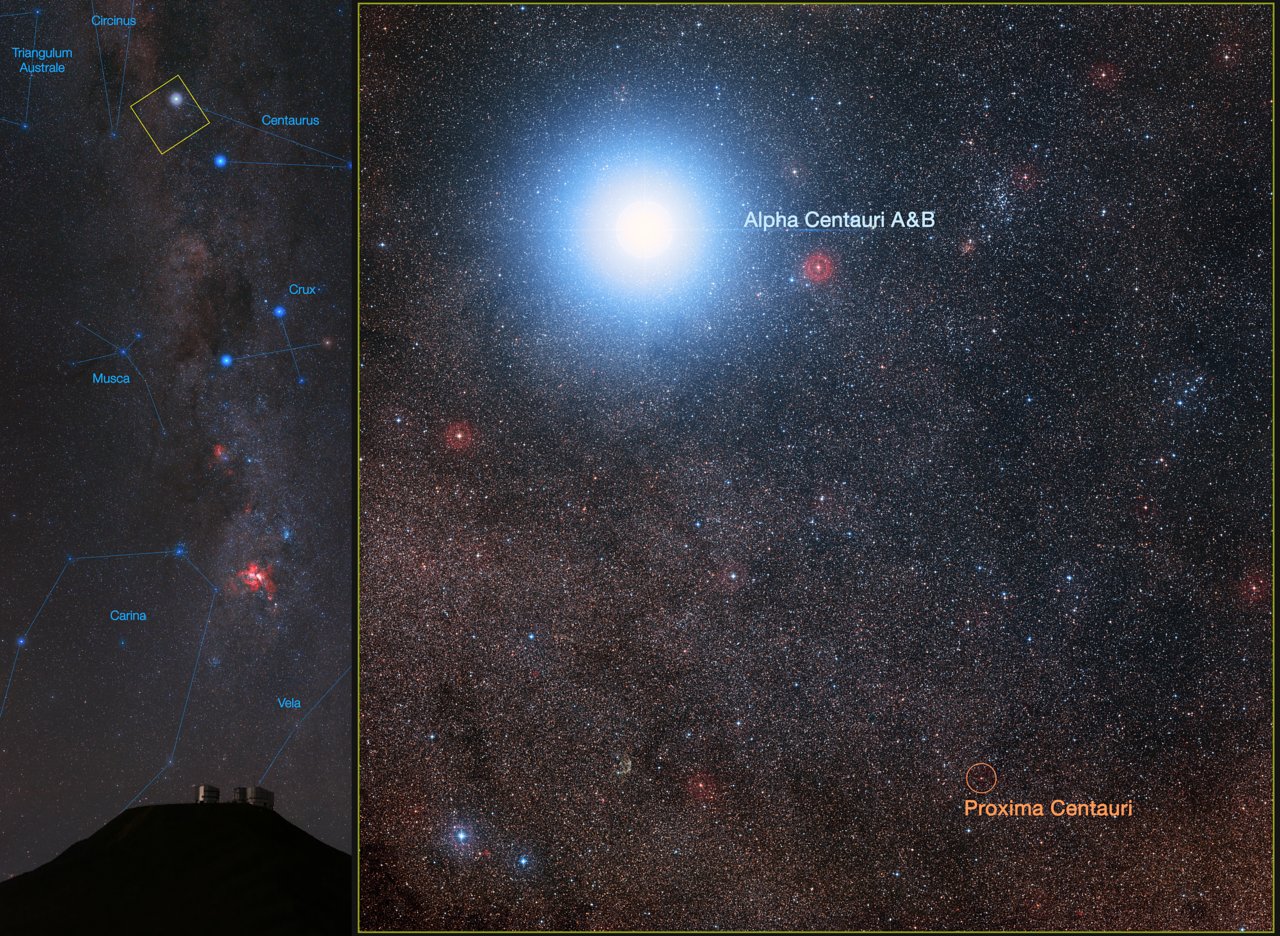
Trisolaris is a planet within a system of three suns of similar mass: in the novel, these are revealed to be Alpha Centauri A, Alpha Centauri B, and Proxima Centauri — the closest stellar system to the Sun, just over four light-years away. The first two stars have masses similar to the Sun, while the third is only about a tenth as massive. Given that none of them exerts a dominant gravitational pull over the other two, orbital motion is not governed by a central body, and no clear hierarchy is present as in ordinary planetary systems. Consequently, the total gravitational field experienced by the planet stems from the combined attraction of all three stars, changing moment by moment depending on their spatial disposition. Their interaction constantly reshapes orbital trajectories, so that they tend towards chaotic behaviour even under the slightest variations in position or velocity.
The planet thus alternates between “Eras of Order”, in which its distance from the suns remains compatible with life due to their quasi-periodic motion, and “Eras of Chaos”, in which it is dragged dangerously nearer to or farther from one or more of them by the rapid and erratic evolution of their orbits. During these cycles, the planet oscillates from intense gravitational stresses and violent irradiation to sudden, severe glaciations. For the Trisolarans, reliable prediction of their planetary system’s dynamics is constrained to timescales of tens or hundreds of years, far too brief to allow a civilisation to plan for its long-term survival. It is therefore an extreme physical scenario, designed to illustrate the dynamical effects of the three-body problem and its high sensitivity to initial conditions.
The three-body problem is a natural extension of the two-body problem in celestial mechanics, where two bodies follow central force motion around their common centre of mass. The type of orbit depends on the system’s total energy, calculated as the sum of kinetic and gravitational potential energy. If the total energy is negative (E < 0), the system is bound by gravitational potential energy, with the two bodies steered to trace a closed orbit — circular or elliptical. Conversely, if the total energy is zero (E = 0) or positive (E > 0), kinetic energy predominates: the orbit is open — parabolic in the former case and hyperbolic in the latter — and the two bodies eventually separate. Owing to the symmetry of the gravitational force, the two-body problem simplifies to an analytically solvable form in which positions and velocities can be calculated exactly.
The addition of a third body breaks this symmetry, though: the equations of motion become non-linearly coupled and no general analytical solution exists. Because each body simultaneously undergoes the gravitational attraction of the other two, the system cannot be reduced to a single relative motion, nor can its future trajectories be written explicitly in terms of the initial conditions. The only way to determine the system’s evolution is to reconstruct its motion over time by means of numerical simulations, which iteratively update positions and velocities as the bodies interact. In practice, this amounts to tracing the system’s dynamical history, knowing that each subsequent configuration derives from the immediately preceding one.
An exception is provided by the so-called collinear or Euler (1707-1783) and equilateral or Lagrange (1736-1813) solutions, representing special configurations of relative equilibrium. In these, the geometric arrangement of the three bodies is preserved in time, forming a rigid figure that rotates collectively about the system’s centre of mass — much as in the two-body problem. The distances between the bodies are set by the balance between mutual gravitational attraction and centrifugal force in the rotating reference frame. In collinear solutions, the three bodies lie along a straight line, whereas in equilateral solutions they occupy the vertices of an equilateral triangle. Although mathematically possible, both classes of solutions turn out to be unstable, since even minimal displacements or tiny variations in mass or velocity can irreversibly disrupt the force balance that holds the bodies in place. This is particularly true for Trisolaris, where the three suns’ similar masses prevent the emergence of a clear primary-secondary hierarchy, significantly narrowing the horizon of predictability.
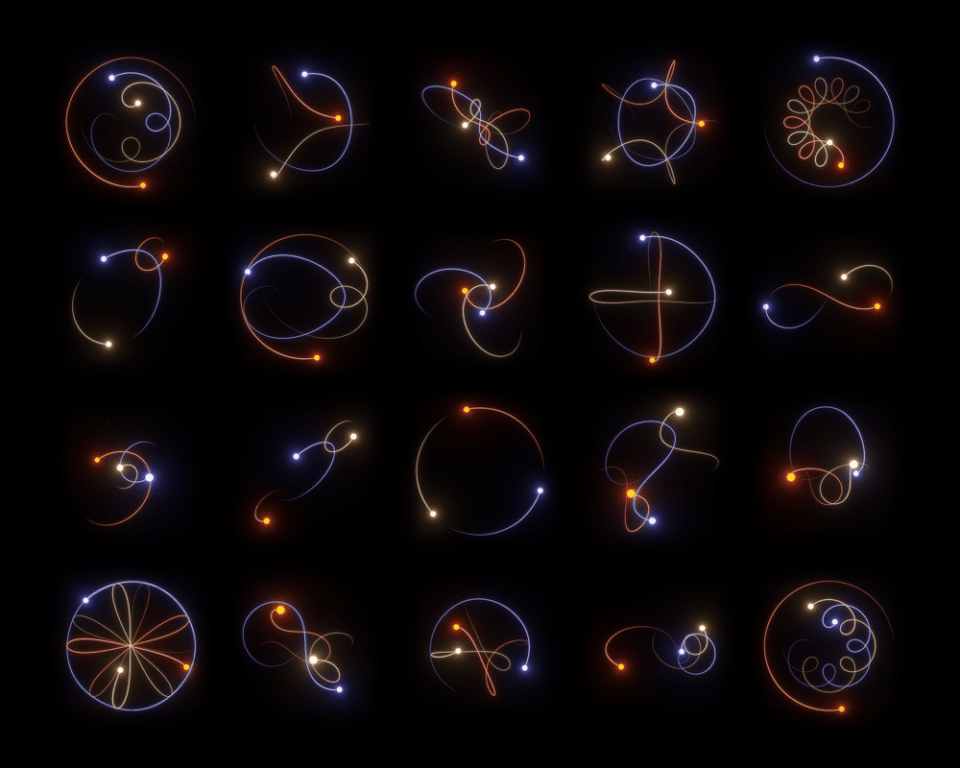
How, then, would the Trisolaran system be studied if it were real? A dynamical simulation of Trisolaris would begin by defining the initial conditions (masses, positions and velocities) of the three suns, and dividing the integration time into very small intervals, called timesteps. At each timestep, a numerical algorithm — typically symplectic, for energy and angular momentum conservation — would recalculate the positions and velocities of each body, avoiding error propagation and ensuring accurate results. This procedure would be iterated across the whole simulation, yielding a dynamical model of the system. Yet, a single model would not be sufficient to encompass the full orbital evolution, requiring an examination of further long-term trends arising from new, slightly perturbed initial conditions relative to the reference configuration. Running a set of parallel simulations would then allow identification of models producing either temporarily regular or divergent orbits. The outcome would thus be a sort of “risk map” of the system, useful for distinguishing between stable and chaotic epochs, and for assessing the likelihood of the planet’s inhabitants’ survival without any preventive intervention.
In order not to succumb to the onset of the “Eras of Chaos”, the Trisolarans would have two options: adapting biologically or modifying the system’s dynamics. As Liu himself suggests, a physically viable strategy would involve enhancing the civilisation’s resilience to abrupt changes in planetary conditions. This considered, rather than acting on bodily resistance — for example by dehydrating during phases of freezing or overheating to minimise metabolic energy consumption — priority could be given to the implementation of cutting-edge technologies to periodically transfer the population away from the planet. Mobile artificial habitats might be hence positioned in circumstellar space, equipped with low-thrust propulsion systems enabling them to slide between the low-risk regions indicated on the map. By contrast, attempts at orbital engineering — such as harnessing stellar radiation pressure or inducing a strong magnetic field around the planet — to shift one or more suns onto a safe orbit would prove far less feasible. Implementing relocation manoeuvres would, in fact, bolster Trisolaran civilisation, which would learn to coexist with chaos based on the statistical knowledge of its three-body system, instead of striving to eliminate it altogether.
Perchance, had they been capable of sustaining themselves in this manner, the Trisolarans would not have felt the urgency to reach out to Earth, and many lives might have been spared. Who knows.…
Nus, 3 February 2026 – English version published on 18 June 2026
Astroglossary
celestial mechanics: a branch of astrophysics that studies the motion of astronomical bodies and the dynamical evolution of the systems they form, using the laws of Newtonian mechanics and general relativity.
two-body problem: the study of the motion of two masses under mutual gravitational attraction in celestial mechanics. Owing to the system’s symmetries and the conservation of energy and angular momentum, the problem reduces to motion in a central field and therefore admits a complete analytical solution.
three-body problem: an extension of the two-body problem in which three masses interact simultaneously through their mutual gravitational attraction. The equations of motion are non-linear and coupled, and as a result no general analytical solution exists. Even small variations in the initial conditions tend to produce markedly different evolutions over time, promoting chaotic behaviour and severely limiting long-term predictability.
numerical simulations: a computational technique employed to study the evolution of complex physical systems whose dynamics do not admit general analytical solutions. They consist of iteratively calculating the positions and velocities of the bodies at discrete time intervals, updating the system’s state at each step according to the equations of motion.
References
Cixin Liu, Il problema dei tre corpi, Italian translation by Benedetta Tavani, Mondadori, 2017, in Italian
Internet Speculative Fiction Database: Liu Cixin, The Three-Body Problem, every edition
The Big Idea: Cixin Liu, Whatever, a conversation of the Chinese author with the US writer John Scalzi, 11 November 2014
Giovanni De Matteo, review of the Italian edition of The Three-Body Problem, Fantascienza.com, 3 March 2018, in Italian
Alpha Centauri Stellar System, 13 June 2023, NASA’s Goddard Space Flight Center Conceptual Image Lab, scientific visualization of the triple star system
“La Sampdoria ispira Il problema dei tre corpi: come una squadra di calcio può dare l’idea per una serie tv”, edited by Vito Lamorte, Fanpage.it, 2 April 2024, in Italian
N-Body Simulator – Interactive 3 Body Problem & Gravitational Dynamics, Trisolarchaos.com, real-time 3D viewer
👉 Click here for other articles of the series Sci-fi Astronomy, edited by Camilla Pianta
