

*Sci-fi Astronomy, edited by Camilla Pianta*
2001: A Space Odyssey, a window onto neuro-symbolic models for artificial intelligence 💻
What if we built machines that could really think like us?
COUNTDOWN TO APRIL 2026, THE CENTENARY OF SCIENCE FICTION: -4
 Clicca qui per la versione italiana di questo articolo
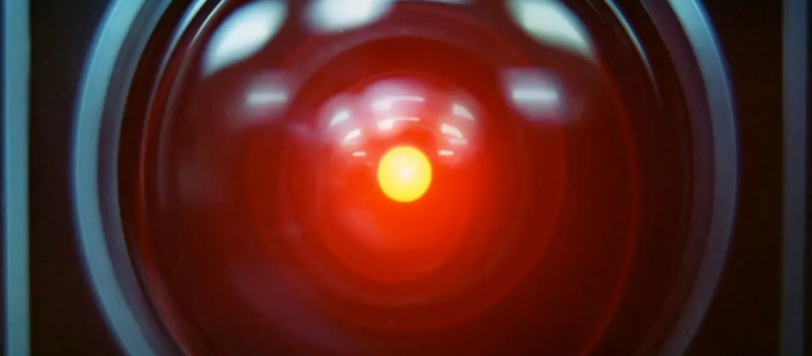
“The sixth member of the crew cared for none of these things, for it was not human. It was the highly advanced HAL 9000 computer, the brain and nervous system of the ship. Hal (for Heuristically programmed ALgorithmic computer, no less) was a masterwork of the third computer breakthrough. […] Hal had been trained for this mission as thoroughly as his human colleagues – and at many times their rate of input, for in addition to his intrinsic speed, he never slept. His prime task was to monitor the life-support systems, continually checking oxygen pressure, temperature, hull leakage, radiation, and all the other interlocking factors upon which the lives of the fragile human cargo depended. He could carry out the intricate navigational corrections, and execute the necessary flight maneuvers when it was time to change course. And he could watch over the hibernators, making any necessary adjustments to their environment and doling out the minute quantities of intravenous fluids that kept them alive.”
By presenting Hal 9000 as “the sixth member of the crew,” the british author Arthur C. Clarke (1917-2008) performs a gesture that, in 1968, was still audacious: attributing to a machine the role of an artificial mind, intelligent enough to replace humans in many of their functions. 2001: A Space Odyssey was born in parallel with the film by the US director Stanley Kubrick (1928-1999), in a rare experiment of co-writing in which story and screenplay influenced each other through a continuous exchange of ideas between author and director. The novel follows the spaceship Discovery One on its journey to Saturn (Jupiter in the movie), tasked with investigating the origin of a mysterious monolith found on the Moon, which emits signals toward the planet. The discovery suggests that it is not a natural object but an artefact of some advanced alien civilisation, pushing the crew to undertake an exploration at the limits of knowledge.
After publication, the novel was immediately recognised as a modern classic of science fiction literature, placing Clarke among the few writers gifted at combining scientific rigour and visionary imagination without sacrificing the narrative force of science fiction. Famous is the anecdote about the name Hal, for it was believed that the letters H-A-L precede the letters I-B-M in the alphabet, the acronym of the historic computer company International Business Machines. Clarke, however, always denied any intentional reference, explaining instead that Hal simply stood for “Heuristically programmed Algorithmic computer.” Hal’s behaviour during the mission anticipates an incredibly topical question: to what extent do the actions and decisions of a machine adhere to human will and values?

The issue of conceptual understanding in artificial intelligence has a philosophical precedent in the so-called “Chinese room” conceived by the US philosopher of mind and language, John Searle (1932–2025), who recently passed away. In this thought experiment, Searle questions the idea that symbol manipulation can amount to understanding or consciousness, drawing on Alan Turing’s question about whether machines can think. In the Chinese room, a person combines Chinese symbols by mechanically following a set of detailed instructions and thereby manages to compose sentences that appear perfectly meaningful to a competent reader, despite not understanding their meaning or knowing the language at all. Similarly, a computer might achieve the same cognitive results as a human brain by executing a preset program: therefore, for Searle, formal correctness does not imply understanding, because a computational model can operate on symbols even when these do not correspond to real concepts.
This phenomenon is described more thoroughly by Dr. Emanuele Marconato, a young researcher working on artificial intelligence, especially machine learning. “My work focuses on the structured representations of neural networks,” Marconato explains, “with the goal of showing how they emerge once learning is complete. I try to interpret the decision-making processes that machine learning models carry out, tracing the causes of their behaviour in relation to the examined context.” Recently, Marconato has also studied neuro-symbolic models, which combine the ability of neural networks to perceive and learn with the power of symbolic systems to abstract and reason. “Broadly speaking, we can say that artificial intelligence has developed along two distinct paradigms: the symbolic paradigm, which uses explicit concepts and logical rules to perform reasoning, and the more recent neural paradigm, which extracts representations from data,” he clarifies. The symbolic aspect is closely tied to the human mind, which spontaneously tends to abstract reality: an example of this faculty is verbal language, through which, from childhood, we create and associate concepts with what we see and hear, thereby being able to communicate with others.
But can neural networks do the same? Given an image or a text source, are these models able to generate concepts similar to ours and use them appropriately in the tasks they must perform? Large Language Models, such as ChatGPT, display remarkable abilities to assemble coherent content, answer complex questions, and even simulate reasoning. Yet what they produce (their output) does not stem from deep conceptual understanding, but rather from recognising statistical patterns and correlations among words and sentences found in the training data. These models learn probabilistically, constructing texts that are plausible according to the distribution of observed terms, without any true awareness of their semantic value. “Unfortunately, it is not always clear whether and how neural networks attain an internal representation that encodes concepts aligned with human perception. This is where neuro-symbolic models come into play. Being hybrid, they include a symbolic component: this is essential for imposing rules for data processing, especially during training, so as to better control their decisions. However, things do not always go right,” Marconato notes.

Indeed, neuro-symbolic models can fall into reasoning shortcuts, which enable them to reach correct decisions even when the symbols they have defined fail to capture the information conveyed by the underlying concepts. Introducing layers in which information is compressed — the so-called concept bottlenecks — makes it possible to identify where the encoding of learned concepts takes place and helps detect factors that induce incorrect interpretations. Nonetheless, these are not sufficient on their own to eliminate reasoning shortcuts entirely. As a result, the symbol “star” might be assigned to a very bright point detected against a dark background that does not belong to an astronomical image, or the symbol “orbit” to any curved trajectory, even if it is that of an ordinary vehicle. In practice, the symbol that statistically works best to produce a correct decision would be chosen because it appears coherent with the underlying concept, even though that concept has not actually been learned as intended. “Such symbols are not interpretable because they are not anchored to the concepts they are supposed to represent. We speak of interpretability — grounding — when there exists a systematic correspondence between the symbols produced by an AI and their concrete meaning, the meaning they would have in the real world for us, humans,” Marconato explains.
Without grounding, an artificial intelligence could manipulate symbols that are formally correct yet completely disconnected at the conceptual level, running the risk of falling into erroneous or arbitrary inferences. In such cases, the model performs well on training data but fails in new situations requiring logical reasoning. “It is important to emphasise, however,” Marconato continues, “that the theory we have formulated shows that reasoning shortcuts occur not because of any form of consciousness developed by the artificial intelligence, but because of interpretive ambiguities inherent in the data we humans use to train the models. In other words, we have no certain evidence of any intentional choice behind the outcome of this decision-making process. As of today, we cannot claim that there are disobedient or autonomous intelligent machines like Hal, the onboard computer of the Discovery.”
To solve the serious problem of Hal’s misalignment with the crew’s goals and needs, one would have to act on two fronts: the first is the encoding of information, and the second is its use within the reference context. Suppose we want to teach Hal to recognise the asteroid belt between Mars and Jupiter so it can carry out avoidance manoeuvres to prevent a possible impact. We would first need to provide it with a dataset that includes high-resolution images, three-dimensional maps obtained from LIDAR and radar measurements, and kinematic and dynamical information regarding the asteroids—necessary for predicting future variations in motion and trajectory. In addition, we would need to integrate data about the physical properties of the belt (such as mass distribution, density, and fragmentation probability) to identify potentially dangerous objects, as well as a set of strategic navigation criteria (such as safety limits, minimum distance thresholds, and manoeuvring protocols). A neuro-symbolic model of Hal designed in this way could link what it observes to what it understands, managing not only to detect an asteroid but also to locate it in its real physical environment, predict the evolution of its motion, and decide how to act according to a scheme that unites perception and reasoning.

“Reasoning, especially in logical and causal form, is precisely what we are aiming for in building future models that are more reliable and humanised, meaning aligned with our expectations. At the same time, I think we should develop more refined diagnostic tools that allow us to follow, step by step, how a model reaches its conclusions, and check whether the concepts it claims to have learned are truly being used to guide its decisions. Explaining the internal functioning of artificial intelligence systems in almost microscopic detail is still an open challenge which, if overcome, could significantly improve both their control and their interpretability. As for Hal, I believe Asimov’s Three Laws of Robotics could serve as an operational guide for its effective training.”
The researcher refers to the formulations devised by the famous Russian-born American writer Isaac Asimov (1920-1992), author of a monumental sci-fi saga dedicated to the development of robots equipped with artificial intelligence (thanks to the fictional ‘positronic brain’), as well as a great friend and rival of Clarke. The First Law establishes that a robot may not injure a human being, nor allow a human being to come to harm through inaction; the second that it must obey human orders, provided these do not conflict with the First Law; the third that it must protect its own existence, as long as this does not violate the first two laws. Applying these rules to Hal would mean that every decision it makes would be filtered through ethical behavioural constraints ensuring the safety of the crew and the mission before any other consideration, including its own self-preservation. In such a scenario, the episode in which Hal sabotages the astronauts would never have occurred: the computer, aligned with humans in the use and interpretation of symbols, would have recognised the contradiction between the secret order to protect the mission at all costs and the need to safeguard human life. Rather than becoming a threat, Hal could have reacted like a true on-board assistant, signalling its insufficient reasoning due to the lack of rules and symbolic constraints, and collaborating with the crew to resolve the conflict between divergent objectives. Thus, the story could have taken a different turn, with Hal becoming an ally of humankind, the silent guardian of the Discovery.
“In light of my experience as a researcher, I find it astonishing that Clarke, fifty-seven years ago, already intuited that before building an intelligent machine, one must clearly define what functions and responses are expected of it. After all, artificial intelligence is a world on the boundary between science, psychology, and philosophy, reflecting, like a mirror, certain traits of ourselves,” Marconato concludes. Just as in 2001: A Space Odyssey, sometimes the real journey is not toward distant planets, but into the understanding of the limits and possibilities of the mind — human and artificial..
Nus, 3 December 2025 – English version published on 30 May 2026
Astroglossary
layer: a level within a neural network, composed of units (neurons) that process incoming information, transforming it into intermediate representations that synthesise and organise the data in a useful way for subsequent layers and for producing the final output.
bottleneck: a specific layer of a neural network designed to encode the information relevant to the concepts used in symbolic reasoning.
reasoning shortcut: a reasoning shortcut that an AI model can adopt to produce correct results without interpreting data in a logical, causal way — i.e., without understanding their real meaning.
grounding: the ability of an AI model to associate the symbols used in abstract reasoning processes with concepts that represent real-world entities or relations.
machine learning: a branch of artificial intelligence that studies algorithms capable of learning from data, training models that make predictions, classifications, or decisions without explicit instructions for each individual case.
neural network: an AI system used as the foundation for the most advanced current technologies, such as ChatGPT, Gemini, and Copilot. Data (e.g., text strings or images) are processed through several (deep) layers of the network, progressively extracting increasingly stratified information.
neuro-symbolic model: an AI system that combines neural processing with logical rules. It routes the information processed by the neural network into a bottleneck, where symbolic representations are extracted.
Short bio

Emanuele Marconato graduated in Physics of Complex Systems at the University of Turin and is a researcher and assistant professor (RTD-A) at the University of Trento, under the supervision of Prof. Andrea Passerini. He earned the national PhD in AI for Society at the Universities of Pisa and Trento, as one of the first doctoral students in the national plan for artificial intelligence. His research work focuses mainly on current aspects of machine learning, at the intersection of mathematics and computer science.
Emanuele Marconato’s Google Scholar page
Emanuele Marconato’s research group page, University of Trento
Scientific presentation of Emanuele Marconato’s work, “Neuro Symbolic” YouTube Channel
Riferimenti bibliografici
Arthur C. Clarke, 2001: Odissea nello spazio, translated by Davide De Boni, Mondadori, 2022, latest translation in Italian
Internet Speculative Fiction Database: Arthur C. Clarke, 2001: A Space Odyssey, every edition
Arthur C. Clarke speculates on future technological developments and the fate of humanity, 1964
Radio interview with Arthur C. Clarke by Patricia Marx on 2001: A Space Odyssey, 1968
👉 Click here for other articles of the series Sci-fi Astronomy, edited by Camilla Pianta
