
*** EXTRAORDINARY PRESS RELEASE ***
As part of a global collaboration, researchers from the Astronomical Observatory of Saint-Barthélemy have published a landmark study on Kallichore, a moon of Jupiter, in the prestigious scientific journal Nature Astronomy
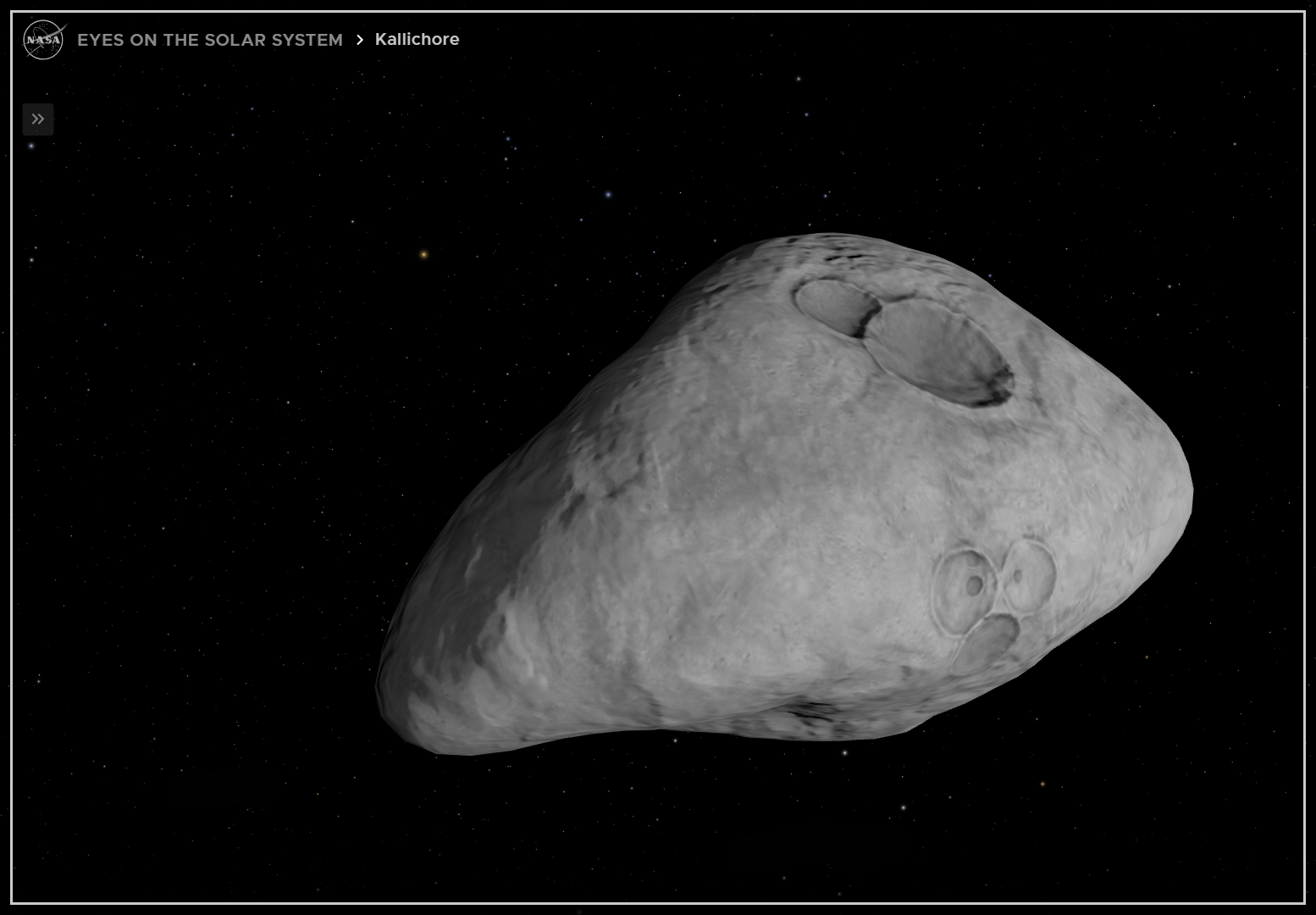
This marks the first physical characterization of one of the smallest irregular moons of the Solar System’s giant planet. The research paves the way for a potential flyby of Kallichore by the European JUICE mission early in the next decade
The Astronomical Observatory of the Autonomous Region of Aosta Valley (OAVdA) was the only facility in the world, within a vast international collaboration, to observe the occultation of a star by the tiny Jovian moon Kallichore, hundreds of millions of kilometers away from Earth. The satellite is named after a nymph (or a muse, according to some versions) in Greek mythology.
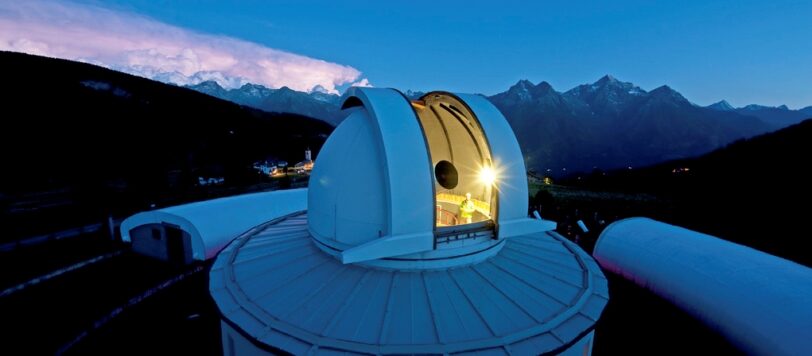
The stellar occultation—a temporary dip in the star’s light caused by Kallichore rapidly passing between the star and Earth, creating a miniature eclipse—lasted just under two-tenths of a second. The OAVdA team optimized targeting and data acquisition methods by combining the operations of three separate telescopes: the 810 mm Main Telescope and two 400 mm telescopes. The observation was conducted on the night between Sunday, December 14, and Monday, December 15, 2025, by Jean Marc Christille, Director of the Fondazione Clément Fillietroz, which manages the astronomical center of Lignan in the Municipality of Nus, and Stefano Sartor, the technologist of the same institution, as part of OAVdA research activities supported by the Fondazione CRT of Turin.
The international study, coordinated by Juan Luis Rizos, a researcher at the Instituto de Astrofísica de Andalucía del Consejo Superior de Investigaciones Científicas (IAA-CSIC) in Granada, Spain, also utilized the famous orbiting Hubble Space Telescope and the Gran Telescopio Canarias, currently the largest operating optical ground-based telescope, boasting an aperture of over 10 meters.
Updated estimates regarding the orbit, shape, size, and brightness of Kallichore, which measures between 4 and 5 kilometers in size, will make it possible to evaluate whether the satellite can be observed in 2031 by the spacecraft of the JUICE (Jupiter Icy Moons Explorer) mission, launched in 2023 by the European Space Agency (ESA). For this reason, Pasquale Palumbo, a researcher at the Institute for Space Astrophysics and Planetology of the Italian National Institute for Astrophysics in Rome (INAF-IAPS) and Principal Investigator (PI) for the JANUS camera onboard JUICE, participated in the study.
The findings were published on Friday, July 24, 2026, in Nature Astronomy, the most authoritative international scientific journal in the sector, with Rizos as the lead author and Christille, Sartor, and Palumbo among the co-authors.
“This discovery fills us with pride and further confirms the international recognition of the scientific work carried out by the Fondazione Clément Fillietroz,” emphasizes the President of the Region, Renzo Testolin. “For over twenty years, the astronomical center of Saint-Barthélemy has been a benchmark for the territory, not only in research but also in educational outreach for schools and the general public. This result proves that the Aosta Valley can achieve levels of excellence even during the period of significant global transformations we are experiencing. Investing in research, as our administration is doing with the Fondazione Clément Fillietroz and the project for the Unified Center of Scientific Research of the Aosta Valley, means investing in the competitiveness, attractiveness, and ultimate growth of our Region.“
In Depth
Kallichore, a natural satellite of Jupiter discovered in 2003, belongs to the Carme group, a cluster of Jovian satellites sharing similar dynamic characteristics. Specifically, they follow orbits of similar shape and inclination in a retrograde direction (opposite to Jupiter’s rotation), which classifies them as irregular satellites. The group is named after Carme, the largest member of these moons, with a diameter of 46 kilometers.
It is believed that the group consists of fragments from an ancient, larger celestial body that was first captured by Jupiter’s gravity and later destroyed, likely due to a collision. This cosmic cataclysm took place billions of years ago.
For Juan Luis Rizos, the significance of the study published today “lies in the fact that Kallichore is the only irregular satellite that could be studied in detail by JUICE, opening a new window into the study of matter and processes present at the origins of the Solar System.” Indeed, the Jovian moon shares properties with Trans-Neptunian Objects (TNOs), whose formation dates back to the beginning of the Solar System’s history, but which are much harder to study because—as their name suggests—they are located beyond the orbit of Neptune, more than four billion kilometers from the Sun.
Although the Carme group is not among the primary scientific targets of the JUICE mission, Callicore could come within range of the probe’s instruments while orbiting the Jovian system, starting with the JANUS multispectral camera and the MAJIS visible-infrared spectrometer, both developed by INAF-IAPS.
According to Pasquale Palumbo, “the main obstacle to planning a close flyby by ESA’s European Space Operations Centre (ESOC) was the significant uncertainty regarding the exact position of the satellite at the time of the flyby, which exceeded 1,500 kilometers prior to this study. Thanks to this work, the team managed to reduce that uncertainty by more than 80%, bringing it down to just 260 kilometers. Furthermore, the study demonstrates that the measurement can be repeated close to the JUICE flyby, guaranteeing even greater precision in determining the satellite’s position, on the order of just a few tens of kilometers.“
With such an improvement, ESA mission managers will be able to assess whether conditions permit scheduling a potential close encounter between the probe and the small Jovian moon in October 2031. “The results obtained allow for a much better evaluation of Kallichore’s potential as a target for JUICE and help maximize the scientific return of the mission,” adds Luisa María Lara, a researcher at IAA-CSIC and co-author of the study.
The opportunity to refine our knowledge of Kallichore came thanks to a rare stellar occultation. By analyzing the catalog of stellar positions measured by ESA’s Gaia mission (active from 2013 to 2025), Juan Luis Rizos’s team discovered that on the night between Sunday, December 14, and Monday, December 15, 2025, at 04:09:42 AM, the tiny Jovian moon would pass between Earth and a 12th-magnitude star (invisible to the naked eye). From the perspective of an observer on Earth, Kallichore briefly hid the star, casting its shadow toward us.
This phenomenon is not as common as one might think: the distribution of celestial bodies in space makes such alignments unlikely. Moreover, the star must be bright enough for the drop in light to be measured effectively; the event itself is extremely brief (in this case, under two-tenths of a second); and finally, the shadow is projected onto Earth along a very narrow path defined by the size of the occulting object.
Thanks to subsequent analyses, in early December 2025, Juan Luis Rizos’s group calculated that Kallichore’s shadow could be observed along a track a few tens of kilometers wide stretching from the United States to the Middle East, which also crossed the Aosta Valley. Consequently, Director Jean Marc Christille enthusiastically accepted the request to join the international collaboration, extended by Pasquale Palumbo in his capacity as Principal Investigator for JANUS.
“At OAVdA, we do not have a digital camera with a fast enough frame rate to capture a two-tenths-of-a-second phenomenon,” comments technologist Stefano Sartor. “However, thanks to the observational expertise gained over our center’s 20-plus-year history, we identified effective alternative solutions in terms of both temporal resolution and maximizing the signal-to-noise ratio.“
Observing this occultation is comparable to looking from Aosta and spotting a 1-euro coin on the southern tip of Greenland as it rolls in front of a 70-watt lightbulb in less time than the blink of an eye. The feat was accomplished using the 810 mm Main Telescope and two 400 mm telescopes on the Scientific Platform. “We wrote a custom algorithm to automatically distribute and optimize the exposure times across the three instruments, covering the necessary timeframe and securing meaningful data,” emphasizes Director Christille. “Having the capability to solve such a complex problem within just a few days is no small feat, given that celestial events don’t wait.“
To understand the value of this research, one need only consider that the astrometric and photometric measurements of Kallichore, in the weeks immediately preceding and following the occultation, involved some of the most advanced instruments in modern astronomy: from the famous Hubble Space Telescope (HST), operated by NASA and ESA, to the Gran Telescopio Canarias (GTC), the world’s largest single-aperture optical telescope, with an impressive diameter of 10.4 meters.
As further proof of the project’s difficulty, out of all the astronomical observatories involved—from the United States and Canada to France and Turkey—only the OAVdA successfully recorded the occultation, as others faced bad weather, technical issues, or unfavorable geographic positioning. “In science, even a negative result is a result, as it places constraints on the phenomenon, and everyone who participated worked just as hard as we did,” comments Jean Marc Christille. “We are pleased with the outcome, but what truly matters is the expertise that allowed us to tackle such a delicate challenge. This body of knowledge, recognized by third-party organizations like the Fondazione CRT, was developed by our staff through basic and applied research and technological transfer, which we make available first and foremost to our local area. This aligns perfectly with the Regional administration’s path toward establishing the Unified Center of Scientific Research of the Aosta Valley, an effort we have wholeheartedly supported from the very beginning.“
References
 Click here to download the official press release (pdf, in Italian)
Click here for the scientific paper: J. L. Rizos et al., including J. M. Christille and S. Sartor, “Kilometre-scale Jovian moon characterized for a potential JUICE flyby”, Nature Astronomy, Volume 10, July 24, 2026 – DOI: 10.1038/s41550-026-02929-z (web, paywall)
Click here for the photo gallery with freely usable images, with attribution (web, captions in Italian)
Click here for the photo gallery from the press conference on Friday, July 24, 2026, at the Regional Palace in Aosta, freely usable with attribution (web)
Click here to read the article on Media INAF, the online newspaper of the Italian National Institute for Astrophysics
Cover Image: Stefano Sartor, technologist at the Fondazione Clément Fillietroz, pictured inside the dome of the 810 mm Main Telescope at the Astronomical Observatory of the Autonomous Region of Aosta Valley, which was used for the Kallichore study as part of an international collaboration. Credit: Courtesy of Livio Piatta/World Images for the Fondazione Clément Fillietroz.
Nus, July 24, 2026 – Article updated on July 30, 2026