

*Sci-fi Astronomy, edited by Camilla Pianta*
Contact, hunting for alien signals 📡
What if we received a message from the cosmos?
COUNTDOWN TO APRIL 2026, THE CENTENARY OF SCIENCE FICTION: -10
 Clicca qui per la versione italiana di questo articolo
“ANOMALOUS INTERMITTENT RADIO SOURCE AT RIGHT ASCENSION 18h 34M, DECLINATION PLUS 38 DEGREES 41 MINUTES, DISCOVERED BY ARGUS SYSTEMATIC SKY SURVEY. FREQUENCY 9.24176684 GIGAHERTZ, BANDPASS APPROXIMATELY 430 HERTZ. BIMODAL AMPLITUDES APPROXIMATELY 174 AND 179 JANSKYS. EVIDENCE AMPLITUDES ENCODE SEQUENCE OF PRIME NUMBERS. FULL LONGITUDE COVERAGE URGENTLY NEEDED. PLEASE CALL COLLECT FOR FURTHER INFORMATION IN COORDINATING OBSERVATIONS.
E. ARROWAY, DIRECTOR, PROJECT ARGUS, SOCORRO, NEW MEXICO, U.S.A.”
This is the content of the scientific bulletin broadcast by Dr. Ellie Arroway, director of Project Argus, to astronomical centres around the world following the reception of a high-intensity radio signal emitted by the star Vega in the novel Contact, published in 1985 by the American astronomer and writer Carl Sagan (1934-1996). Within the narrative, Project Argus is a research initiative that falls under the SETI (Search for Extraterrestrial Intelligence) program: a vast array of radio telescopes created to monitor the sky in search of signals originating from alien civilisations.
The name “Argus” is inspired by the mythological figure of the hundred-eyed giant Argus Panoptes, in reference to the system’s ability to survey the entire radio spectrum at all times. Project Argus represents an evolution compared to traditional SETI search methods — which generally focus on individual stars or limited regions of the sky —, since it employs an enormous network of small radio telescopes to ensure broader spatial coverage, thereby increasing the chances of intercepting suspicious emissions. Under the leadership of the protagonist Ellie Arroway, a determined astronomer seeking scientific proof of intelligent extraterrestrial life, Argus plays a crucial role in the discovery of the radio signal described in the bulletin. This signal appears highly structured and includes a sequence of prime numbers, a clear indication of an artificial origin. Its decoding will reveal instructions for building a not-well-identified technological device, which could nonetheless enable human beings to make contact (hence the title of the novel) with the inhabitants of one of the planets associated with Vega.

Although the version depicted in Contact is fictional, SETI’s Project Argus truly exists as a union of amateur and professional radio astronomers who aim to develop a global radio telescope network for continuous sky monitoring, drawing directly on what Sagan wrote.
The SETI program originated between the 1950s and 1960s, when scientists began to seriously consider the possibility of capturing radio signals from extraterrestrial civilisations. The first formal experiment, known as Project Ozma, was conducted by astronomer Frank Drake (1930-2022) at the National Radio Astronomy Observatory (NRAO) radio telescope in Green Bank, West Virginia. Drake pointed the telescope at two nearby stars, Tau Ceti and Epsilon Eridani, tuning it to a frequency of 1,420 MHz, corresponding to the 21-cm emission line of neutral hydrogen, the most abundant element in the universe. Drake believed this frequency could serve as a kind of universal meeting point and thus be strategic for interstellar communication. Despite the failure to detect signals of artificial origin, from that experiment onward the intensity and extent of efforts to identify signs of alien life increased significantly.
At the core of SETI lies the idea that technologically advanced civilisations might use radio waves to communicate with humans. Unlike other forms of electromagnetic radiation, radio waves can pass through interstellar dust clouds with minimal interference, making them suitable for transmitting signals across long distances. Moreover, radio astronomy was already an expanding field at the time, with the construction of major facilities such as Arecibo and the Very Large Array (VLA). In subsequent years, the SETI project experienced substantial progress thanks to more sophisticated instruments and the collaboration of a great many observatories.
In 1974, Frank Drake and Carl Sagan sent the famous Arecibo message toward the globular cluster M13, in order to notify potential extraterrestrial intelligences of humanity’s existence. The message consisted of a radio signal with a frequency of 2.38 GHz and a power of about 1 MW, composed of 1,679 bits (binary digits) containing information about Earth, the Solar System, and human biology. Once decoded, these bits were meant to generate a series of stylised explanatory images. In particular, the number 1,679 was not random: it had been deliberately selected as the product of the prime numbers 73 and 23, to indicate a mathematical intentionality in the message. The hope was that the presumed intelligent recipients would recognise this property and try to arrange the bits in a grid of 73 rows and 23 columns (or vice versa) to obtain a meaningful image. It should nevertheless be remembered that the message was conceived more as a symbolic experiment than as a genuine attempt at contact, given the distance of M13 — located 25,000 light-years from Earth: the signal would have taken 25,000 years to reach its destination, and an equal amount of time would have had to pass before a reply could be received. Furthermore, the motion of M13 relative to Earth had to be taken into account, as it could have caused the target stars to shift while the information was travelling toward their original positions.

Source: https://www.setileague.org/admin/DrakeObit.htm
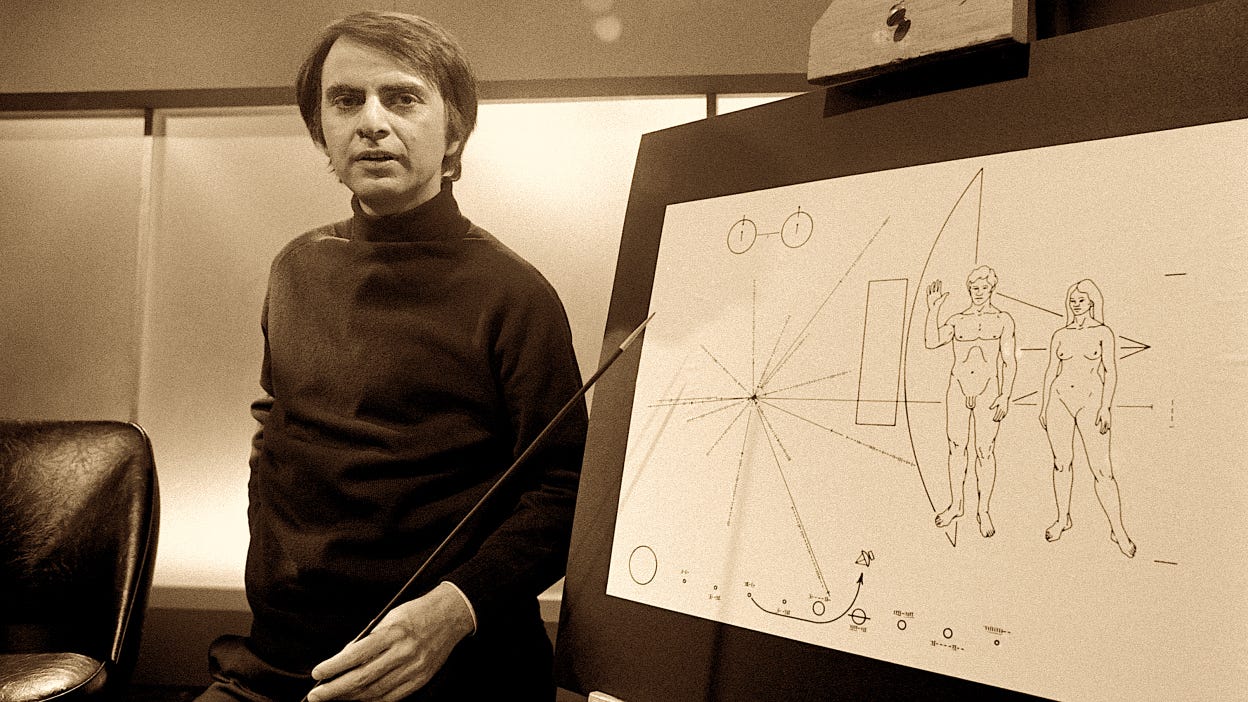
Despite these limitations, Sagan continued his pursuit of interstellar communication through the realisation of the Pioneer Plaques and the Voyager Golden Records. The Pioneer Plaques are two anodised aluminium plates incised with gold. They were sent into space aboard the Pioneer 10 and Pioneer 11 probes in the early 1970s, with the purpose of providing a comprehensible message to a hypothetical alien civilisation that might intercept them in the distant future. Each plaque showed two diagrams: one of the position of the Sun relative to 14 pulsars, intended to facilitate its localisation, and one of the hyperfine transition of hydrogen, a universal physical phenomenon that can serve as a unit of measurement for lengths and times. In addition, the plaques featured a naked man and woman next to a representation of the spacecraft, to provide a reference for human body dimensions. The Voyager Golden Records, by contrast, are two gold-plated copper discs on the Voyager 1 and Voyager 2 probes, launched in 1977. Comprising a collection of sounds, images, and music emblematic of Earth’s culture, these discs were accompanied by an aluminum cover that included a diagram explaining how to interpret the visual information, along with instructions for playback with a dedicated stylus.
Today, SETI focuses on identifying anomalous signals using state-of-the-art radio telescopes and new machine-learning computational algorithms to collect and analyse large data volumes in ever shorter timeframes. The goal remains unchanged: to find traces of alien technologies and determine whether intelligent life is a common or rare phenomenon in the universe. However, even if a radio signal were detected in a modern SETI experiment, we could know with certainty that another intelligence exists, but not necessarily understand what it is saying. First of all, to distinguish extremely weak signals from background cosmic noise, astronomical instruments must integrate them over long periods of time, summing the information received throughout observations. This method, however, has the side effect of smoothing out any fluctuations present: in other words, the rapid and detailed variations of the original signal, which might conceal an encoded message, would be flattened, rendering it unreadable. Secondly, the matter of distance must be considered. A hypothetical civilisation orbiting a nearby star would still have to wait years to establish contact with Earth, since its message would need to traverse trillions of miles of space before reaching the planet; in the case of a more distant civilisation, centuries or even millennia would pass. Consequently, a true dialogue would be impractical due to enormous time delays. Finally, the evolutionary path followed by an extraterrestrial intelligence might profoundly diverge from that of humankind: deciphering an intelligible message could prove an immense task, as it would require the ability to correctly interpret the way of thinking of a potentially very different species.
Source: https://club.drawtogether.studio/p/diy-golden-record
All in all, although the detection of an alien signal would constitute an epoch-making event, technical, temporal, and cultural challenges would stand between humanity and the decryption of the received message. The solution might reside in a multidisciplinary approach, combining the expertise of archaeologists, anthropologists, and linguists to extract meaning from fragments of information. These difficulties highlight the complexity of SETI research, which, moving past the purely scientific domain, invites reflection on the real possibility of interstellar communication.
The universe exists on a spatial scale that defies our imagination, yet we persist in seeking signs of something — or someone — beyond ourselves. As Ellie Arroway emphasises: “The universe is a pretty big place. If it’s just us, it seems like an awful waste of space.” Perhaps, in the end, the deepest question is not whether we are alone, but whether we are ready to accept the answer.
Nus, 4 June 2025 – English version published on 11 May 2026
Astroglossary
Hz: hertz, unit of frequency.
MHz: megahertz, one million hertz.
GHz: gigahertz, one billion hertz.
Jy: jansky, unit of electromagnetic flux.
W: watt, unit of power.
MW: megawatt, one million watts.
DEC: declination, an astronomical coordinate measuring the position of a celestial object relative to the celestial equator, analogous to terrestrial latitude. It is expressed in degrees, arcminutes, and arcseconds. Objects located exactly on the celestial equator have a declination of 0°, those above it have positive values up to +90° at the North Celestial Pole, and those below it have negative values down to −90° at the South Celestial Pole.
RA: right ascension, an astronomical coordinate indicating the position of an object along the celestial equator, analogous to terrestrial longitude. It is measured in hours, minutes, and seconds of time, with zero fixed at the gamma point (vernal equinox). Right ascension increases eastward, covering a range from 0 to 24 hours, corresponding to a full 360° rotation around the celestial sphere.
References
Carl Sagan, Contact, translation by Fabrizio Ascari, Urania Jumbo, Edizioni Mondadori, 2025, in Italian
Internet Speculative Fiction Database: Carl Sagan, Contact, every edition
Douglas A. Vakoch Ed., Archaeology, anthropology, and interstellar communication, NASA eBook, 2014
👉 Click here for other articles of the series Sci-fi Astronomy, edited by Camilla Pianta
