


*Sci-fi Astronomy, edited by Camilla Pianta*
Tau Zero, beyond the boundaries of relativity 🚀
What if a spacecraft could travel at the speed of light?
COUNTDOWN TO APRIL 2026, THE CENTENARY OF SCIENCE FICTION: -3
 Clicca qui per la versione italiana di questo articolo
“Throughout her year at one gravity, the differences between Leonora Christine and the slow-moving stars had accumulated imperceptibly. Now the curve entered upon the steep part of its climb. Now, more and more, her folk measured the distance to their goal as shrinking, not simply because they traveled, but because, for them, the geometry of space was changing. More and more, they perceived natural processes in the outside universe as speeding up. It was not yet spectacular. Indeed, the minimum tau in her flight plan, at midpoint, was to be somewhat above 0.015. But an instant came when a minute aboard her corresponded to sixty-one seconds in the rest of the galaxy. A while later, it corresponded to sixty-two. Then sixty-three . . . sixty-four . . . the ship time between such counts grew gradually but steadily less . . . sixty-five . . . sixty-six . . . sixty-seven. . . .”
An American author and a leading figure of the so-called Golden Age of science fiction, Poul Anderson (1926-2001) is remembered for his ability to fuse scientific rigor with prose that remains at once intricate and lucid. Anderson belonged to the generation of writers who, between the 1950s and 1970s, brought hard science fiction to maturity, treating scientific ideas as the very framework upon which the narrative is built, rather than purely incidental color. Tau Zero, inspired by his short story ‘To Outlive Eternity’, which appeared in 1967 in Galaxy magazine and was later published as a standalone novel in 1970, is almost unanimously regarded as the high point of Anderson’s career, a rare synthesis of narrative momentum and strict fidelity to Einsteinian relativity. Though deeply technical, the novel earned immediate recognition from critics. In 1971 it was a finalist for the Hugo Award, and in the years since it has been consistently republished as a landmark of contemporary science fiction.
Part of the novel’s lasting power comes from the radical scope of its premise: a spacecraft — the Leonora Christine — is pushed to a constant acceleration of 1 g, sustained long enough to drive its crew ever closer to the speed of light and thereby into the very heart of special relativity. Accordingly, the title Tau Zero is no mere literary flourish, but the interpretive key to the story itself. In relativistic physics, tau (τ) denotes proper time — the time measured by an observer moving along with the object. Near the speed of light c, the spacecraft’s proper time lags increasingly behind the time of the outside universe. The title therefore refers to the limit τ → 0, a condition in which, from the travellers’ perspective, time aboard the spacecraft nearly stops while cosmic time races ahead. It is both a physical and philosophical boundary: the point at which the subjective experience of time becomes fully detached from the universe’s history, opening the way to the cosmological events of maximal space-time distortion described in the novel.

Center: A portrait of the author Poul Anderson. Source: https://2084futurosimaginados.org/en/guardians-of-time-new-york-ballantine-books-1960/
Right: The cover of the most recent Italian translation of Tau Zero (Editrice Nord, 1989, latest reprint 2002), featuring an illustration by Angus McKie. Source: https://www.anobii.com/it/books/tau-zero/9788842903956/013de77fd3011ecfdd
To comprehend the transformation of space and time in the relativistic regime, one must first consider Newtonian mechanics, developed by the British physicist and mathematician Isaac Newton (1642-1727), where observations are conducted within inertial reference frames, that is, systems in uniform straight-line motion relative to one another, where the laws of physics are identical for all observers. These systems are called Galilean, named after the Italian physicist and astronomer Galileo Galilei (1564–1642). No reference frame is privileged: each one is equivalent, provided that their relative velocity is accounted for. Space and time are absolute, or more precisely, independent of the frame in which they are measured. Time flows at a constant rate everywhere and distances do not change, so that two observers in relative motion will agree on the durations of events and the lengths of objects. These notions, however, cease to apply at velocities approaching the speed of light, for time dilation and length contraction — two effects predicted by the German physicist Albert Einstein (1879-1955) with the theory of special relativity — enter into play.
Suppose two clocks, one stationary on Earth and the other aboard a spacecraft, are perfectly synchronised. To an Earth-bound observer, the spacecraft’s clock will appear to tick increasingly slowly as the spacecraft accelerates toward the relativistic limit. The astronaut, by contrast, notices nothing unusual: the clock on board, marking proper time, behaves normally, while the Earth-bound clock seems to run faster. Similarly, imagine a rod positioned on Earth along the direction of the spacecraft’s motion. The Earth-bound observer will measure the rod’s proper length (that is, its rest length), whereas the astronaut by timing the arrival of light from its two ends and factoring in their own motion, will find that the rod is shortened.
In Tau Zero, time dilation intensifies to such an extent that proper time and cosmic time can no longer be meaningfully compared. One year after departure, the Leonora Christine was already travelling close to the maximum velocity permitted. Seen from Earth, the voyage across interstellar space to the destination star Beta Virginis would have spanned more than thirty-one years, excluding the time required for deceleration and landing. By contrast, the crew inhabits a different temporal domain, for the succession of days slows dramatically with respect to Earth as the factor τ steadily declines. When τ falls to one hundredth, the spacecraft will traverse one hundred light-years in a single year of proper time: thus, while only a year is lived aboard the spacecraft, a hundred years pass in the external universe. Furthermore, as a consequence of length contraction, the spatial separations between cosmic objects streaming by at an accelerated pace seem to be progressively compressed to the travellers. The overall impression is that of a Big Crunch: a universe in gravitational collapse, where space-time itself shrinks until it is reduced to a point known as a singularity.
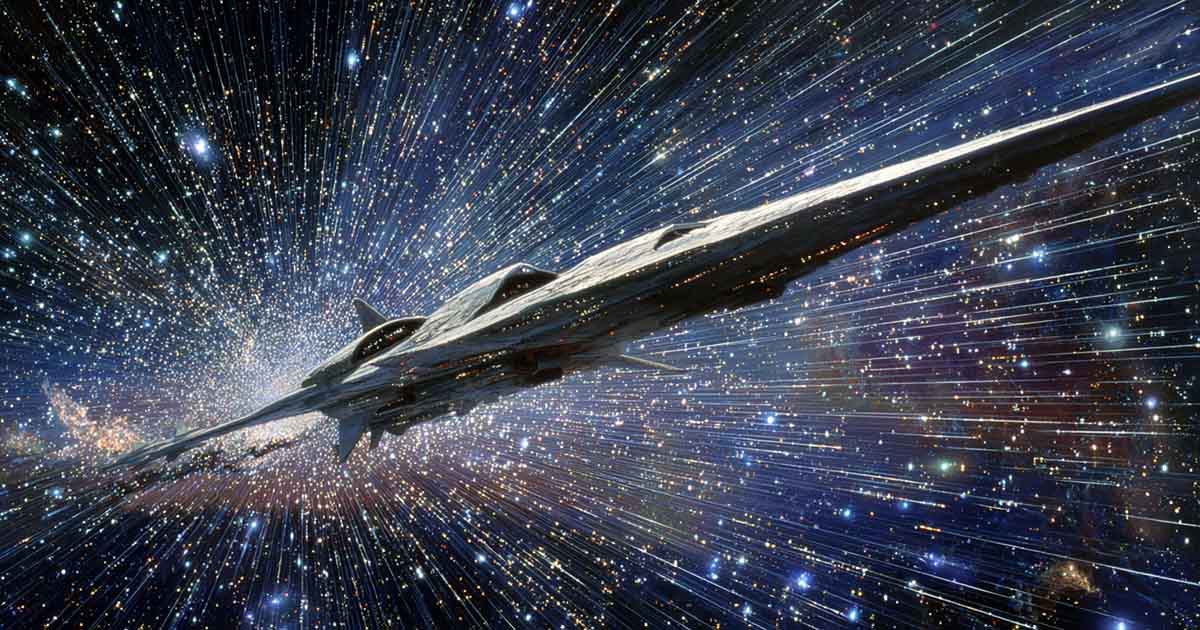
In cosmology, a Big Crunch occurs when the average density of matter and energy in the universe exceeds a critical value: gravity overpowers expansion — the very scenario the standard cosmological model does not anticipate — and space starts to contract, forcing galaxies to converge upon a point of infinite density. The singularity generated at the completion of this process denotes the final stage of a closed universe, one that is not fated to perpetual expansion. Conversely, in cyclic or oscillating models, the universe undergoes alternating phases of expansion, marked by a Big Bang, and contraction, terminated by a Big Crunch, bereft of an absolute beginning or a definitive end. The transition from contraction to expansion is achieved through the bounce mechanism: the collapse is reversed before a singularity can form, halting the contraction and initiating a new cycle in which the universe expands again from conditions similar to those of the prior cycle.
Among the principal examples of cyclic universes are the ekpyrotic model and the quantum bounce model. The ekpyrotic model, named after the Greek ἐκπύρωσις (ekpýrosis, “conflagration”), originates within brane cosmology, where brane theory is brought to bear on the large-scale evolution of the universe. In this context, branes are multidimensional entities that extend the concept of strings from one-dimensional objects to three-dimensional surfaces. All fundamental interactions (electromagnetic, weak, and strong) are confined to these surfaces except for gravity, which is free to propagate through the surrounding four-dimensional space-time referred to as the bulk. Each brane represents a universe in its own right — endowed with matter, energy, and intrinsic physical laws — and the dynamics of every cycle is governed by interactions between adjacent branes: when two branes approach one another, a concentration of attractive potential energy builds up in the region of their mutual influence. At the moment of their collision, the accumulated energy is released in a single event (hence the term conflagration) and converted into radiation and matter, producing an exceptionally hot, Big Bang–like state on the branes. This sudden release of energy triggers the subsequent phase of expansion, corresponding to the separation of the branes involved. They may later be pulled back together if the attractive potential, rising with distance, succeeds in overcoming the kinetic energy acquired during the impact, decelerating them until their motion is inverted.
Unlike the ekpyrotic model, in which the bounce is implicit in the approach, collision, and separation of branes, the quantum bounce model envisions a cyclic universe where quantum mechanics intervenes to prevent the Big Crunch from culminating in a singularity. Quantum fluctuations — small oscillations of matter and energy at scales near the Planck length, below which classical physics demands quantum corrections — generate repulsive forces acting as an internal pressure within space-time. These forces counteract gravitational collapse, arresting it and turning it into expansion: the bounce, induced by the additional quantum terms, ensures that the transition proceeds smoothly, without any discontinuity.
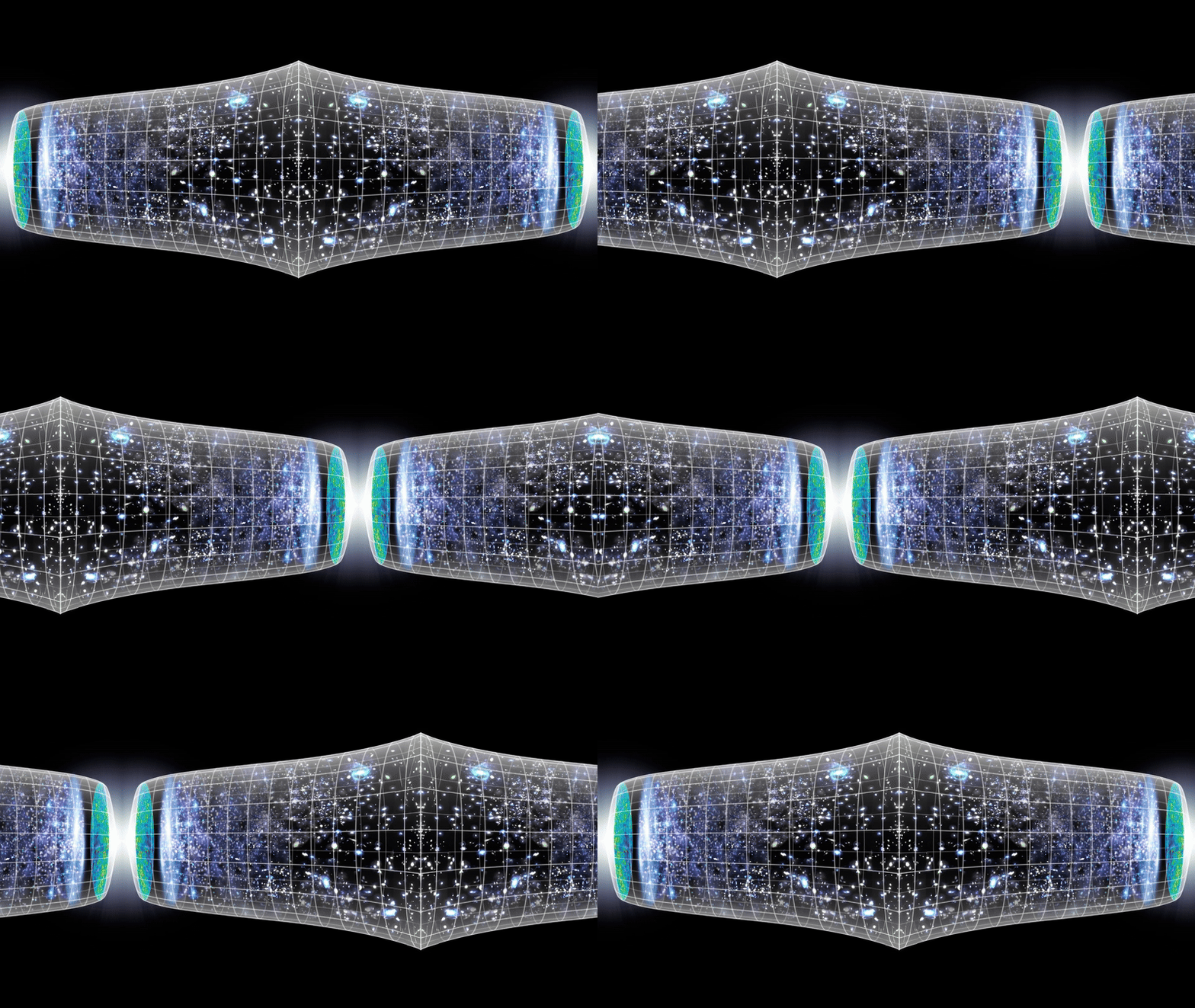
The universe of Tau Zero, nevertheless, is not cyclic in the strict cosmological sense, for the Big Crunch progresses all the way to the formation of a singularity, with the emergence of a new universe lacking a true transition from the previous one. Contrary to bounce models, collapse and rebirth are considered distinct events, allowing the Leonora Christine to pass through the singularity even in the absence of a plausible physical explanation for the survival of matter in a region of infinite curvature. But what if the spacecraft were drawn into the singularity of the Big Crunch and failed to emerge into another universe, or if it were to experience the bounce of a conventional cyclic universe?
In the former scenario, the universe’s average density and the space-time curvature would diverge, leading to tidal forces far beyond the structural capacity of any material and sufficient to sever the bonds between biological molecules. These forces are exerted on extended bodies immersed in a gravitational field with a steep gradient, causing differential accelerations between their constituent parts. A spacecraft heading for a singularity would thus be subjected to greater acceleration along the axis of motion (the direction of the gravitational gradient), so that its front and rear would be drawn apart as if “stretched” in opposite directions. Concurrently, the object would be compressed laterally, in directions perpendicular to the stretching, since neighbouring geodesics — the curved paths followed by objects under the exclusive action of gravity — are forced to converge by the intense space-time curvature. The combination of longitudinal stretching and transverse compression in the vicinity of a gravitational singularity is commonly termed “spaghettification”.
In the latter scenario, this tragic destiny is averted: the density and curvature of space-time reach a finite maximum, past which the contraction phase cannot persist following the onset of the bounce. Consequently, gravitational stresses remain within tolerable limits, and the spacecraft suffers no deformation as cosmic dynamics reverses. Although the external universe shifts from collapse to expansion in infinitesimal fractions of a second, proper time aboard the spacecraft maintains its regular course owing to the asymptotic degree of time dilation, enabling the crew to endure the bounce over a humanly accessible interval. The Leonora Christine would hence enter a new cosmic cycle, its voyage continuing unscathed and its members unharmed.
Dissolution of space-time: such awaits the universe of Tau Zero, dragged to the edge of Einsteinian relativity by the Big Crunch. An epilogue that reveals neither annihilation nor salvation, but leaves hanging the ultimate question: can anything truly be conceived beyond the singularity?
Nus, 2 gennaio 2026 – English version published on 1 June 2026
Astroglossary
1 g acceleration: a constant acceleration of 1 g means that the spacecraft is speeding up at the same rate as a freely falling object on Earth, 9.81 m/s². Each passing second adds 9.81 metres per second to its velocity.
galilean reference frame: an inertial frame in which the laws of classical mechanics apply and a free body — that is, one not subject to external forces — moves in a straight line at constant speed. Any two Galilean frames in uniform rectilinear motion relative to each other are related through Galilean transformations: these modify spatial coordinates, while time remains absolute and universal.
proper time: the time measured by a clock moving with a given object or reference frame. It corresponds to the internal time experienced by the system in motion and is defined by dτ = dt √(1 − v²/c²), where dt is the coordinate time in an inertial frame, v the velocity of the object, and c the speed of light.
time dilation: the relativistic effect whereby a clock in motion relative to an observer runs more slowly than an identical clock at rest. If Δτ is the proper time and Δt the time measured by an observer for whom the clock moves with velocity v, then Δt = γ Δτ, with γ = 1 / √(1 − v²/c²) the Lorentz factor. As a result, any physical process occurring in a system moving at relativistic speed appears delayed relative to an external observer.
length contraction: the relativistic effect whereby an object’s length along the direction of motion appears shortened to a stationary observer. If L₀ is the object’s proper length and L the length measured in a frame in which it moves at velocity v, then L = L₀ / γ = L₀ √(1 − v²/c²).
standard cosmological model: also known as the ΛCDM model, it provides a description of the universe on large scales as homogeneous and isotropic, based on the field equations of general relativity applied to a Friedmann–Lemaître–Robertson–Walker (FLRW). In spherical coordinates, the FLRW metric is written as ds² = −c² dt² + a(t)² [ dr² / (1 − k r²) + r² (dθ² + sin²θ dφ²) ], where t is cosmic time, r, θ, φ are spherical spatial coordinates, a(t) is the scale factor determining the expansion of the universe, and k denotes the spatial curvature (k = 0 for a flat universe, k = +1 for a closed universe, and k = −1 for an open universe). The universe’s content is dominated by ordinary matter, cold dark matter (CDM), and dark energy, the latter represented by the cosmological constant Λ, which drives the current phase of accelerated expansion.
Big Bang: a cosmological model derived from the solutions of the Friedmann equations, portraying the primordial universe as a state of extremely high density and energy, from which the expansion of space-time originated.
Big Crunch: a cosmological scenario in which the expansion of the universe halts and reverses, causing space-time to contract globally until it collapses into a singularity.
singularity: a domain of space-time in which the gravitational field quantities — curvature, energy density, and the like — diverge toward infinity, so that the equations of general relativity fail to provide a valid physical account.
References
Internet Speculative Fiction Database: Poul Anderson, Tau Zero, every edition
Sandro Pergameno, introduzione al romanzo IL FATTORE TAU-ZERO di Poul Anderson COSMO – CLASSICI DELLA FANTASCIENZA – Volume n. 98 (Gennaio 1989), published online in Andromeda – Rivista di fantascienza, in Italian
M. Gorgio, “Tau Zero” and the Legacy of Classic Science Fiction, 6 October 2025, non-fiction essay
M. Malaspina, “In viaggio verso Proxima Centauri con Albino Carbognani”, 21 December 2025, review published on the Media INAF website about the book Destinazione spazio profondo. Verso Proxima e Barnard per esplorare nuovi pianeti (Dedalo, 2025) dedicated to the scientific hypotheses for achieving interstellar flight, in Italian
👉 Click here for other articles of the series Sci-fi Astronomy, edited by Camilla Pianta
